- Posted on: 22 March, 2021
- 50 Years Old
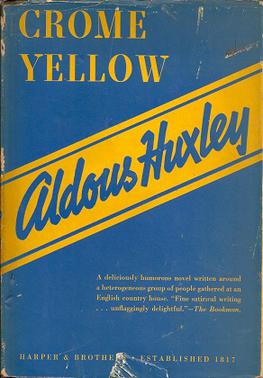
- Aldous Huxley
- #1922 #50 #Crome Yellow #Denis Stone #Male #Mr Barbecue-Smith #Novel
 Donate
Mr Barbecue-Smith 50
Mr. Barbecue-Smith suddenly became extremely confidential. He pulled up a stool to the side of Denis’s arm-chair, sat down in it, and began to talk softly and rapidly.
“Listen to me,” he said, laying his hand on Denis’s sleeve. “You want to make your living by writing; you’re young, you’re inexperienced. Let me give you a little sound advice.”
What was the fellow going to do? Denis wondered: give him an introduction to the editor of “John o’ London’s Weekly”, or tell him where he could sell a light middle for seven guineas? Mr. Barbecue-Smith patted his arm several times and went on.
“The secret of writing,” he said, breathing it into the young man’s ear—“the secret of writing is Inspiration.”
Denis looked at him in astonishment.
“Inspiration…” Mr. Barbecue-Smith repeated.
“You mean the native wood-note business?”
Mr. Barbecue-Smith nodded.
“Oh, then I entirely agree with you,” said Denis. “But what if one hasn’t got Inspiration?”
“That was precisely the question I was waiting for,” said Mr. Barbecue-Smith. “You ask me what one should do if one hasn’t got Inspiration. I answer: you have Inspiration; everyone has Inspiration. It’s simply a question of getting it to function.”
The clock struck eight. There was no sign of any of the other guests; everybody was always late at Crome. Mr. Barbecue-Smith went on.
“That’s my secret,” he said. “I give it you freely.” (Denis made a suitably grateful murmur and grimace.) “I’ll help you to find your Inspiration, because I don’t like to see a nice, steady young man like you exhausting his vitality and wasting the best years of his life in a grinding intellectual labour that could be completely obviated by Inspiration. I did it myself, so I know what it’s like. Up till the time I was thirty-eight I was a writer like you—a writer without Inspiration. All I wrote I squeezed out of myself by sheer hard work. Why, in those days I was never able to do more than six-fifty words an hour, and what’s more, I often didn’t sell what I wrote.” He sighed. “We artists,” he said parenthetically, “we intellectuals aren’t much appreciated here in England.” Denis wondered if there was any method, consistent, of course, with politeness, by which he could dissociate himself from Mr. Barbecue-Smith’s “we.” There was none; and besides, it was too late now, for Mr. Barbecue-Smith was once more pursuing the tenor of his discourse.
“At thirty-eight I was a poor, struggling, tired, overworked, unknown journalist. Now, at fifty…” He paused modestly and made a little gesture, moving his fat hands outwards, away from one another, and expanding his fingers as though in demonstration. He was exhibiting himself. Denis thought of that advertisement of Nestle’s milk—the two cats on the wall, under the moon, one black and thin, the other white, sleek, and fat. Before Inspiration and after.
